Impeachment of Philippines Vice President Moves Rivalry Between Country’s Top Political Clans to New Level
The president, Ferdinand ‘Bongbong’ Marcos, whose father in 20 years as a dictatorial president imposed martial law, is facing off against the Duterte family while the current vice president looks for redemption on behalf of the clan.
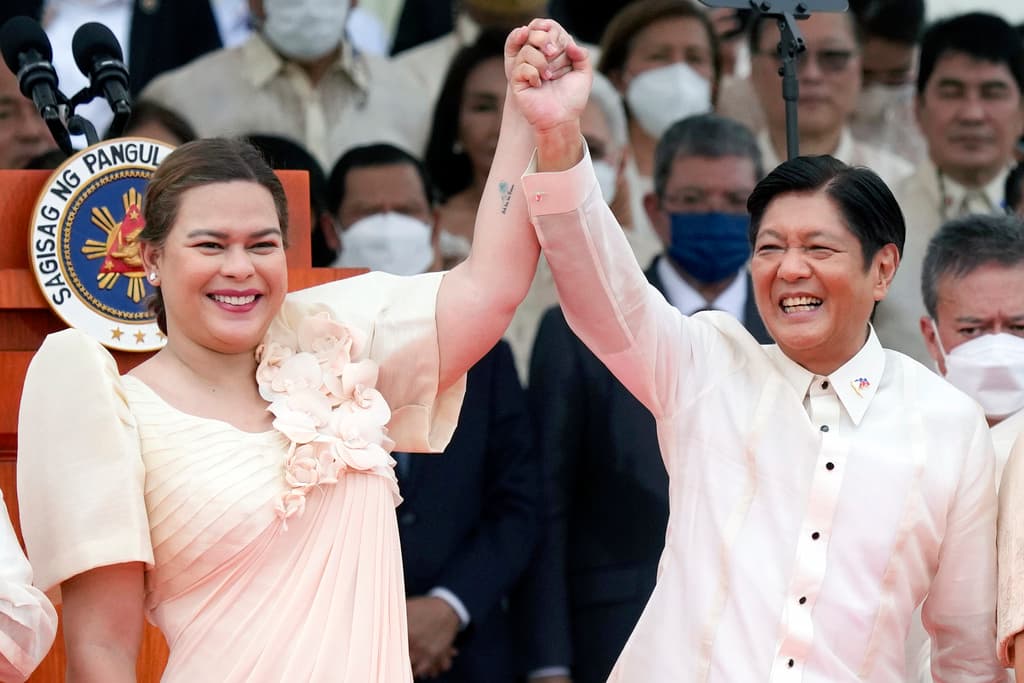

The Philippines is entering the next phase of an epic struggle between the country’s two most powerful political clans with the impeachment of the country’s vice president, Sara Duterte.
She’s the Philippines’s no. 2 under the president, Ferdinand “Bongbong” Marcos, son of the late Ferdinand Marcos, driven into exile in the 1986 “People Power” revolution. Yet she’s really a surrogate for her father, Rodrigo Duterte, president for six years before Bongbong’s election in 2022.
The charges against Ms. Duterte, at 46 the country’s youngest vice president, range from corruption to a seeming threat to have the current president, his wife, and his cousin killed. In the crazy world of rivalries among the Philippines’s leading families, though, she’s by no means a spent force.
The corruption of which Ms. Duterte is accused — draining more than $10 million in funds from her budget — is trivial compared to that of Mr. Marcos’s parents, said to have cached $10 billion in foreign accounts. His father died in exile in Hawaii in 1989. His mother, Imelda, is 95.
Nor did Ms. Duterte’s assassination threat seem all that serious, even though she said in a speech it wasn’t “a joke.” She let it be known later she was just kidding. What the rift means is that Mr. Marcos, whose father in 20 years as a dictatorial president imposed martial law, faces the Duterte family while the current vice president looks for redemption on behalf of the clan.
Ms. Duterte was impeached by a vote of 215 of the 306 members of the Philippines’s house of representatives, but she’s still the vice president at least until June, when the country’s senate convenes and votes on the motion. That gives her plenty of time to marshal her own campaign against Bongbong’s rule.
Never mind that Ms. Duterte was on the same ticket as Mr. Marcos in the 2022 presidential election. Her father, barred by the 1987 constitution, couldn’t go for a second term but convinced her to run instead.
Drawn together in a marriage of convenience, Bongbong and Ms. Duterte lead different political parties. In the Philippines, voters cast their ballots separately for president and vice president. After winning by wide margins, they fell apart while Mr. Marcos softened the brutal war on drugs that her father had waged against dealers and users.
Mr. Duterte could not succeed himself under the constitution that was enacted after the downfall of the senior Marcos, but he saw his daughter as carrying on his legacy until, perhaps, either she could run for president or he could run for a second term. Like her father, Ms. Duterte had honed the skills of a tough politician while serving as mayor of Davao, a brawling port city on the large southern island of Mindanao.
Philippine representatives were righteous in their wrath against Ms. Duterte. One of them, Chel Diokno, called her impeachment “a testament to the power of active citizenship,” according to the Philippine Star. “The senate must not falter,” he said. “This is a moment of truth. Will they stand with the people or enable the rot of unaccountability?”
The oratory, however, masked the power of the Duterte family in the south versus that of the Marcos family, based in a province far north of Manila. Both of them have amassed huge wealth while installing relatives in powerful positions.
Messrs. Marcos and Duterte differ, though, in their views of big-power rivalries. Mr. Duterte as president cozied up to China while belittling the American role in the region. Mr. Marcos counts on American support against Chinese claims to the South China Sea.
For Mr. Duterte, an “independent foreign policy” would guarantee security. Mr. Marcos has renewed historic close ties with Washington. The Philippines, the Institute for China-America Studies said, was “playing the U.S. card to deal with China.”

